
The operating environment for industrial, logistics, and infrastructure-led businesses has become structurally less predictable. Supply chain disruption, climate volatility, economic uncertainty, and shifts in trade flows now sit as standing items on most strategic risk registers, rather than periodic shocks to be weathered and forgotten. Marsh estimates that supply chain disruptions cost businesses around $184 billion a year, with roughly two-thirds of companies carrying at least one active bottleneck in their network at any given time.
For GCC organisations operating across logistics, energy, construction, manufacturing, and government sectors, the implication is straightforward. Long-term infrastructure decisions can no longer assume the conditions of the previous decade. Infrastructure planning has moved from a capital allocation question into the centre of business continuity strategy.
When fixed infrastructure becomes a liability
Conventional construction was built around assumptions that are increasingly fragile: stable supply, predictable lead times, fixed locations, multi-year horizons. Where those assumptions still hold, traditional methods remain efficient. Where they do not, rigidity carries a quantifiable cost.
Three operational pressures sharpen this picture.
- Material lead times for steel, mechanical equipment, and specialist components have lengthened well beyond pre-2020 norms, particularly for specifications concentrated in a small number of suppliers.
- Construction labour markets across the region remain tight, with skilled trades in short supply on large infrastructure programmes.
- Capital exposure to a single, fixed asset is harder to defend at board level when the operational footprint of the business may need to flex within twelve months.
The result is a quieter but consistent shift in how senior teams evaluate infrastructure proposals. Permanence, once treated as a default virtue, is now examined on its own terms. Long lead times, sunk capital, and assets that cannot be relocated or repurposed all read as concentrated risk in an environment where the business case may move faster than the building itself.
Resilience as a planning principle
Infrastructure resilience is not another term for temporary buildings. It is a principle that the assets supporting a business should be able to absorb disruption without loss of operating capability, and adapt as the operating model itself evolves.
In practical terms, that means infrastructure that can be deployed in weeks rather than years, scaled up or down with project phase, relocated when geographies change, and disengaged cleanly at handover. It also means assets that hold residual value across multiple use cycles, rather than depreciating against a single project lifecycle. This is not new thinking, but its weight inside corporate planning has shifted. What was once a tactical question handled by procurement is now a strategic input into capex committees, project execution plans, and risk frameworks.
Where modular and container-based infrastructure fits
Modular and container-based infrastructure has emerged as one of the most practical responses. McKinsey’s analysis of modular construction puts schedule compression at 20% to 50% relative to conventional methods, and the global modular construction market itself was valued at around $103.5 billion in 2024, projected to reach roughly $162.4 billion by 2030 at a CAGR close to 7.9%. The growth is driven less by novelty than by fit. Modular assets answer a set of problems that conventional construction is structurally less suited to solve.
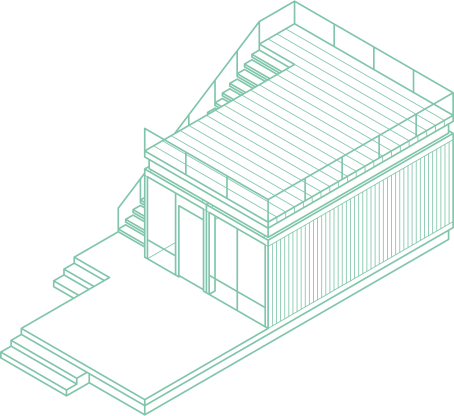
Container-based infrastructure inherits the same logic, with additional advantages where mobility, durability, and cost predictability matter. Standardised ISO containers offer a known structural envelope, established certification frameworks (IICL repair standards and Container Safety Convention compliance), and access to deep regional stocks across GCC ports. They lend themselves to a wide range of applications without requiring bespoke design from first principles.
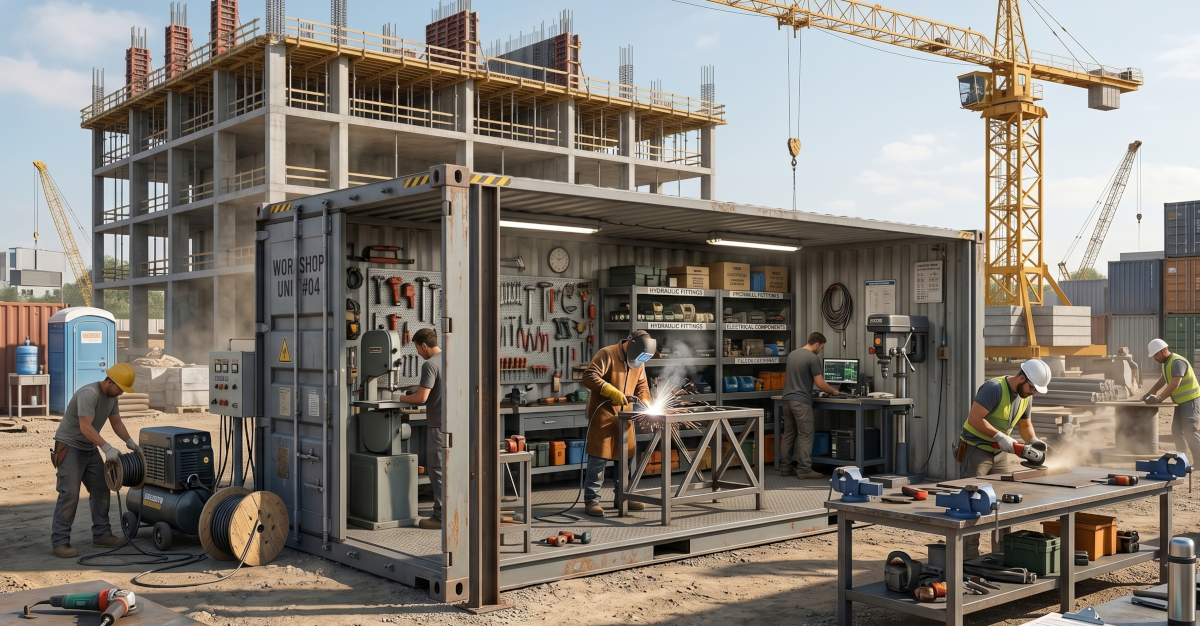
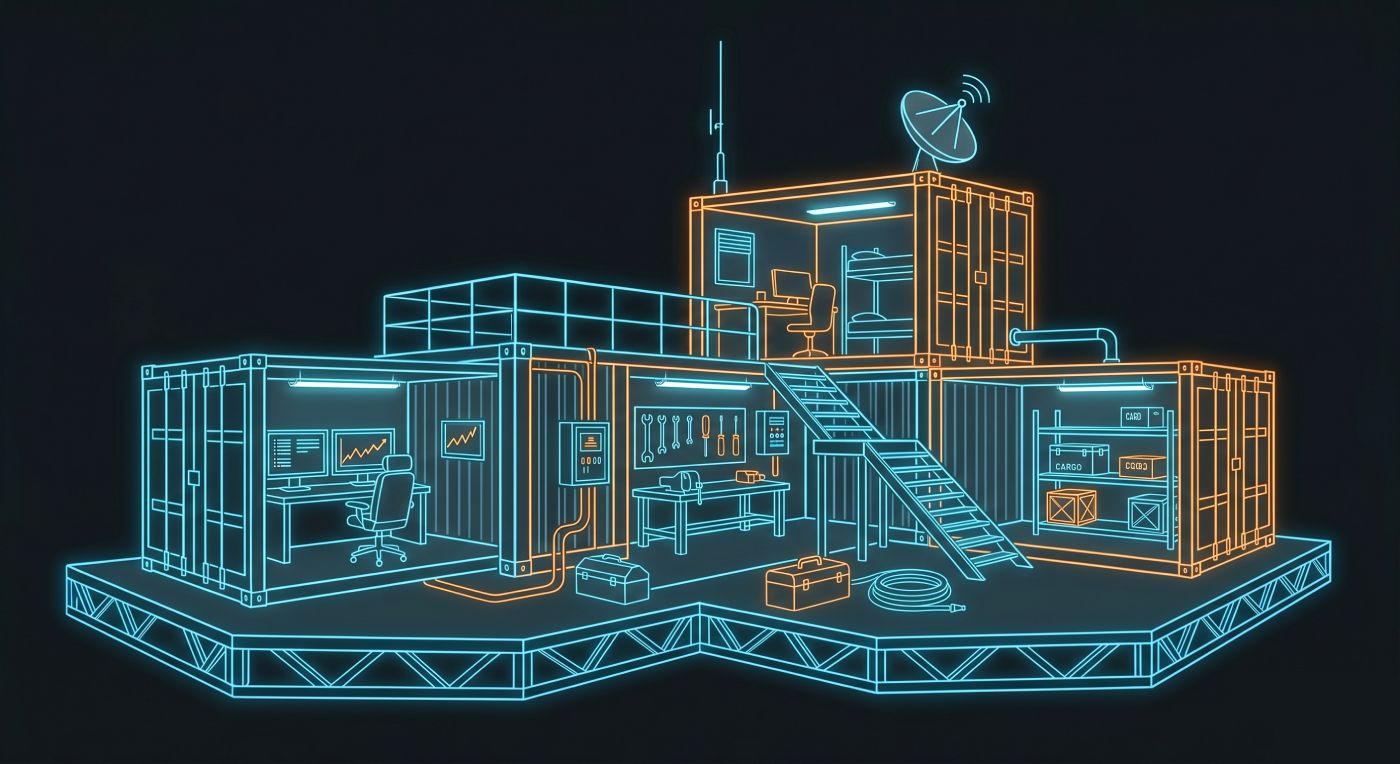
Across industries, container-based infrastructure now supports operational and welfare offices on remote sites, technical workshops and equipment stores, modular control rooms and communications cabins, hazardous material storage built to chemical compatibility standards, and rapid-deployment industrial and logistics depots. Many of these structures, originally specified as interim solutions, remain in use well beyond their initial timeline. The reason is straightforward. They continue to deliver the flexibility, durability, and cost control that fixed-build alternatives cannot match in dynamic operating environments.
Why this resonates across the GCC
The GCC’s combination of high-tempo project activity and developed port logistics makes it one of the most natural environments for modular and container-based infrastructure. The wider Middle East and North Africa region accounts for the largest share of global oil and gas project pipeline activity tracked by GlobalData, alongside substantial parallel activity in petrochemicals, LNG capacity, port and logistics infrastructure, water and desalination, and the giga-scale developments now underway across Saudi Arabia and the wider region.
These projects operate on compressed schedules, with multi-contractor environments, remote or industrial-zone locations, and limited tolerance for delay. Procurement cycles for properly specified modular or container-based assets, sourced regionally through established yards in Jebel Ali and other major ports, can be measured in weeks rather than months. That timing advantage is often the difference between an infrastructure plan that supports a project’s schedule and one that constrains it.

Building for what comes next
Resilience in infrastructure is no longer a contingency measure. It is increasingly the design assumption, built into how serious operators plan, finance, and execute long-cycle work. The organisations approaching it that way are reducing exposure to the disruptions still working through the global system, while preserving the option to redeploy assets as their own operating models evolve.
Boxcare designs and delivers container-based and modular infrastructure across the GCC, drawing on its base at Jebel Ali Port and its position within the DP World group. From technical workshops and operational offices to control rooms, storage units, and bespoke conversion projects, every unit is built on a structurally sound, certified container and configured against the operational profile of the host project.
For organisations evaluating where adaptable infrastructure fits into the next phase of their work, the Boxcare team is available to discuss specifications, applications, and regional logistics directly at boxcare.ae/contact-us.