
For industrial operators across the GCC, the cost of standing still has rarely been steeper. Research from the Siemens True Cost of Downtime study estimates that the world’s largest companies now lose roughly $1.4 trillion a year to unplanned downtime — close to 11% of their combined revenues, and well above pre-2020 levels.
These figures translate directly into the realities of running an industrial site: idle crews waiting for parts, paused fabrication on energy projects, missed milestones on infrastructure programmes, and contractual penalties that compound by the day. Against a background of stretched and unpredictable global supply chains, the maintenance model many operators inherited, which is built around fixed, off-site workshops and just-in-time spares … is no longer fit for the operating environment most projects now face.
One response is gaining real traction: shifting maintenance and fabrication capability onto the site itself, in the form of fully fitted-out containerised workshops.

The new operating environment
Global supply chains have not returned to the rhythm that was, although few signs suggest they will. Marsh’s Sentrisk data indicates that supply chain disruptions cost businesses an estimated $184 billion annually, with around two-thirds of companies reporting at least one active bottleneck somewhere in their network. Lead times that used to be measured in days now stretch into weeks or months for specialised components, particularly where production is concentrated in a small number of suppliers.
The knock-on effects are well understood by anyone running an industrial site. A single missing component can ripple through a maintenance schedule. A delayed crane part can stall a port. A late hydraulic spool can pause a drilling rig.
Two further pressures are reshaping the picture. The first is the steady contraction of skilled labour available in remote project locations, which is a structural trend that affects everything from infrastructure programmes in the GCC’s industrial corridors to upstream operations in the Empty Quarter and Dhofar. The second is the rising operational risk profile of the maintenance function itself: high-profile cyber incidents at large manufacturers have demonstrated how a single disruption to digital systems can halt production across multiple sites at once, putting renewed weight on locally controlled infrastructure that does not depend on a remote chain of services.
Why traditional maintenance models are breaking down
The conventional approach to industrial maintenance that includes a hub-and-spoke model in which fixed workshops in regional capitals or industrial zones serve a network of project sites — was designed for an operating environment with predictable logistics and reliable lead times. Equipment travelled to the workshop. Spares arrived on schedule. External technicians were dispatched as required.
That model still works, but the margins around it have narrowed considerably. The transport leg now adds days to any repair, particularly for projects in remote desert, coastal, or offshore locations. External service crews compete for the same scarce labour pool. Off-site fabrication and welding capacity becomes a queue rather than an instant resource. And spare parts inventory held at central warehouses is increasingly mismatched with the actual mix of equipment in use across a project portfolio.
For routine, planned work, none of this is fatal. For unplanned breakdowns, every additional handover is a multiplier of risk.
Containerised workshops: capability moved to the source of work
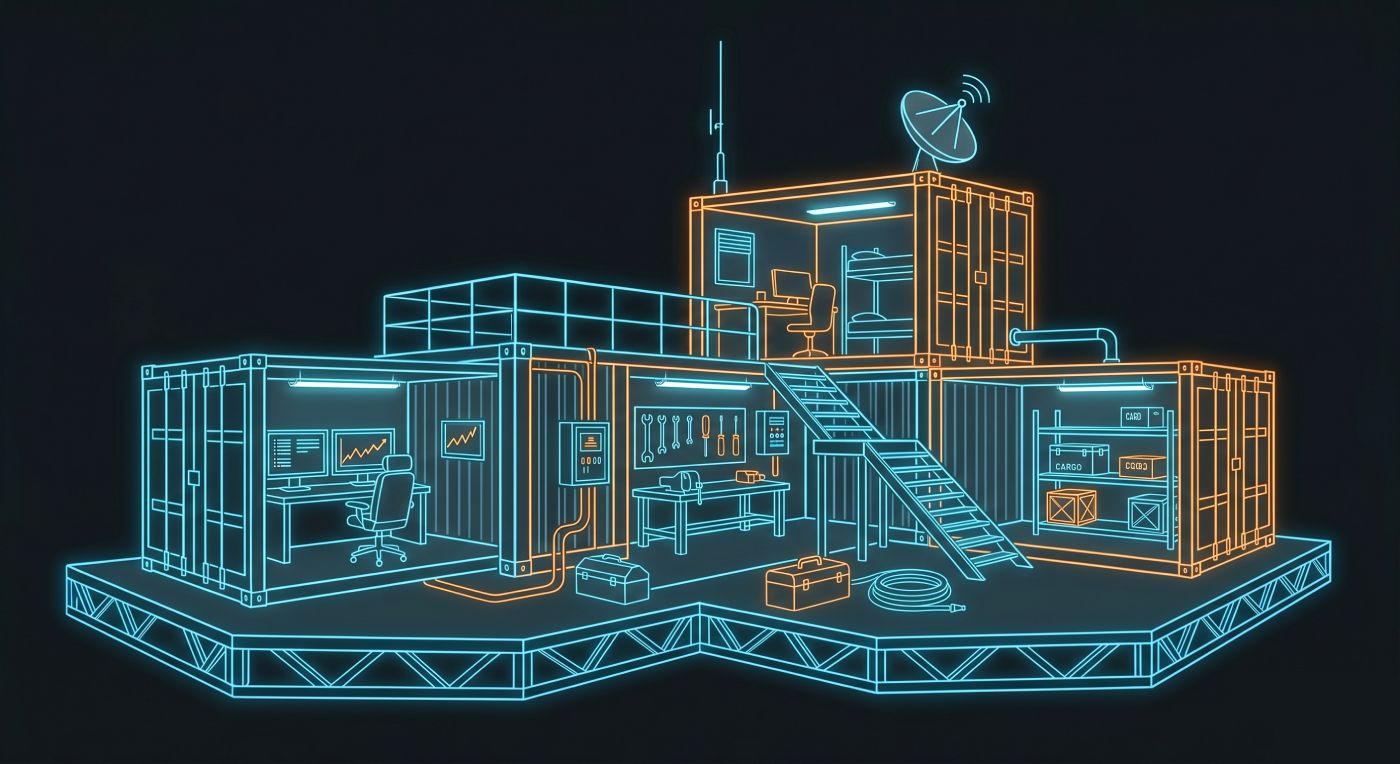
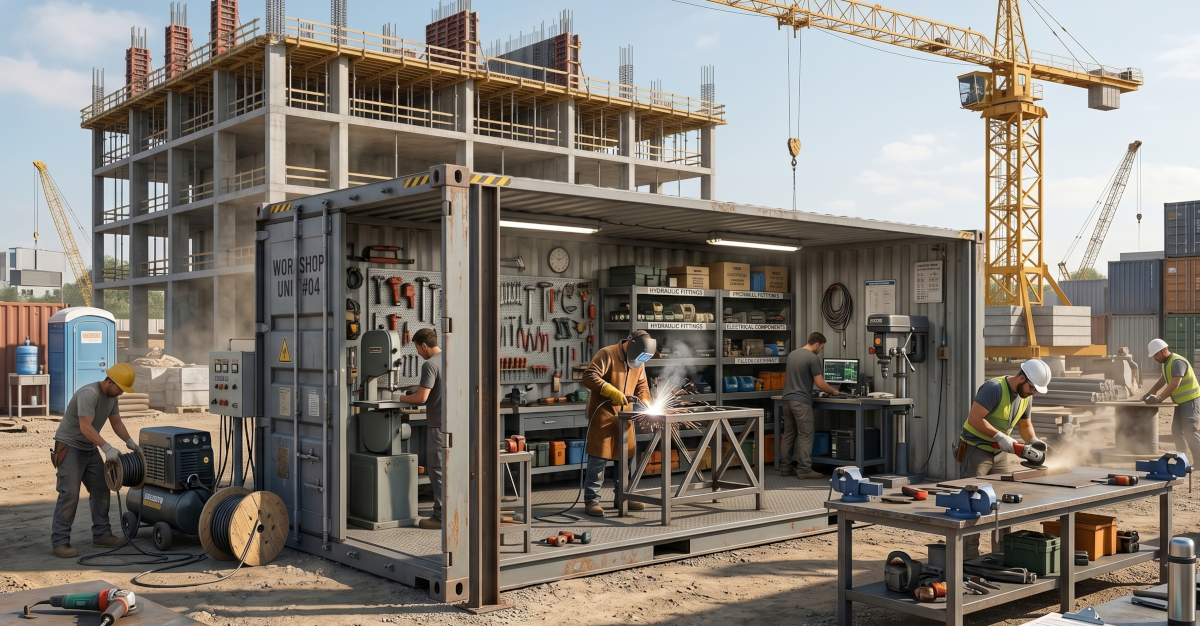
A containerised workshop is exactly what the name suggests: a fully equipped maintenance, fabrication, or technical-services workspace built into a converted ISO shipping container, deployable directly to the site where the work happens. Done well, it places the functional capability of a fixed workshop within the project boundary, removing the transport leg entirely for most repair scenarios and absorbing far more of the maintenance workload locally.
The base unit is typically a 20-foot or 40-foot container — and increasingly the High Cube variant where vertical clearance matters — structurally repaired to International Institute of Container Lessors (IICL) standards and Container Safety Convention (CSC) certified for transport. From there, the build varies considerably by purpose. A mechanical workshop unit will carry reinforced flooring, anchored workbenches, hydraulic press mounts, vice stations, lighting and ventilation rated for industrial use, and racking sized for the spares profile of the host equipment. An electrical and instrumentation workshop will prioritise ESD-safe surfaces, cleaner air handling, calibration benches, and protected storage for sensitive instruments. A welding and fabrication unit will need fume extraction, fire suppression, and gas storage compatible with local HSE codes.
For deployments into oil and gas, petrochemical, or offshore environments, the structural specification steps up further. DNV 2.7-1 certification covers padeye design, structural integrity under offshore lift conditions, and safe operation in classified hazardous areas. Specifications can be extended to ATEX or IECEx compliance for units intended to operate in zoned environments around hydrocarbon processing.
Insulation and climate engineering matter as much as the structural shell. GCC ambient temperatures regularly exceed 45°C through the summer months, and coastal sites add humidity and chloride exposure to the corrosion profile. Workshops intended for sustained use require appropriate insulation panels, HVAC sized for the actual heat load (including equipment output, not just ambient), corrosion-protective coatings, and electrical systems specified for the full operating envelope rather than a generic temperate-climate baseline.
What containerised workshops are deployed for
The application range is wider than most operators initially assume.
- Mechanical and hydraulic repair bays cover routine and breakdown maintenance of pumps, compressors, valve assemblies, and heavy plant.
- Electrical and instrumentation workshops support calibration, testing, and minor rework on site, removing the need to ship instruments back to a central facility.
- Welding and fabrication shops handle structural repairs, pipe fabrication, and minor steelwork without the lead time of an off-site queue.
Beyond the core workshop functions, the same chassis is used for tool stores with shadow boarding and RFID tagging for high-value assets, NDT and QA inspection cabins built around document-controlled workflows, hazardous material stores engineered to chemical compatibility standards with secondary containment, sound-attenuated generator housings that give a remote site genuine power independence, and containerised control rooms running SCADA, communications, or temporary command facilities during shutdowns and turnarounds.
In each case, the design intent is the same: keep capability inside the project fence, reduce dependence on the external logistics chain, and shorten the cycle from problem identification to problem resolution.
Why this matters in the GCC right now
The GCC sits at the centre of one of the most active industrial construction markets in the world. The Middle East and North Africa account for roughly $980 billion of the global oil and gas project pipeline tracked by GlobalData. The GCC pipeline construction market alone reached just over $1 billion in 2025 and is projected to grow at a CAGR of around 5.3% through 2034, according to IMARC Group’s analysis. That sits on top of substantial parallel activity in petrochemicals, LNG capacity expansion, port and logistics infrastructure, renewable generation, water and desalination, mining-adjacent processing, and giga-scale developments such as those underway in Saudi Arabia and the wider region.
The GCC also has a structural advantage in this regard: the region’s port infrastructure — anchored by Jebel Ali alongside Jeddah, King Abdullah Port, Hamad, Khalifa, Sohar and others — gives operators access to deep, standardised container stocks and regional fabrication capacity. Procurement cycles that might run into months in less developed logistics environments can compress to weeks for a properly specified containerised workshop sourced within the region.
From contingency to strategic asset
What was once treated as a temporary or stopgap solution is now being written into long-term operational planning. Modular, deployable maintenance assets appear increasingly in contracting strategies, project execution plans, and capital budgets.
Containerised assets retain residual value and can be redeployed across multiple projects over their lifecycle. They allow capability to scale up and down with project phase rather than sitting idle between mobilisations. They reduce reliance on external service providers in markets where skilled labour is genuinely tight and they sit naturally alongside the broader move toward modularisation that is reshaping industrial construction across upstream, midstream, and downstream segments.
For operators planning into 2026 and beyond (through what is likely to remain a volatile global supply chain environment) the case for keeping critical maintenance capability inside the project boundary is no longer a marginal one.
Working with Boxcare
Boxcare designs and delivers containerised workshops, control rooms, stores, and bespoke modification units across the GCC, drawing on its base at Jebel Ali Port and its position within the DP World group. Every unit starts on a structurally sound, IICL-grade container, CSC-certified for transport, and is configured against the specific operational profile of the host project — whether that is a heavy mechanical bay for an upstream oil and gas operation, an instrumentation workshop for a petrochemical complex, or a fast-deployable site office for an infrastructure programme.
For operators evaluating where containerised maintenance infrastructure fits into the next phase of their work, the Boxcare team is available to discuss specifications, fit-out options, and regional logistics directly at boxcare.ae/contact-us.