

If you live or work in the GCC, you’ve seen how fast the landscape is changing. New cities, logistics corridors, tourism destinations, and industrial mega-projects are reshaping the region from Riyadh to Muscat. The scale is extraordinary — but so is the challenge. Governments and businesses alike are asking the same question: how do we build smarter, faster, and more sustainably?
Shipping-container-based modular construction is emerging as one of the most compelling answers. What were once temporary steel boxes for moving cargo are now being converted into fully functional offices, cafés, retail units, clinics, worker accommodations, and industrial facilities — often delivered in a fraction of the time and cost of traditional building methods. Here’s why container-based modular infrastructure is gaining serious ground across the GCC, and why Boxcare is at the centre of this transformation.
The GCC modular container market is booming
The modular container sector in the GCC is not just growing — it’s accelerating. A 2026 industry report valued the GCC modular container market at USD 6.2 billion, powered by rapid urbanisation, large-scale infrastructure investment, and increasing demand for sustainable, quickly deployable buildings (kenresearch.com).

Saudi Arabia is one of the biggest drivers, having committed over USD 175 billion annually toward industrial and mega-project development, which directly fuels demand for modular construction (kenresearch.com). Meanwhile, the UAE modular construction market alone is projected to grow from USD 1.58 billion in 2025 to USD 2.75 billion by 2033, at a 7.2% compound annual growth rate (grandviewresearch.com). The message is clear: the region is ready for modular solutions that deliver speed, sustainability, and cost efficiency.
Speed that matches the region’s ambition
In a region where deadlines are aggressive and opportunities are time-sensitive, modular construction can cut project timelines by up to 50%, particularly in rapidly developing markets across the GCC (saudimarketresearchconsulting.com). Off-site fabrication — now common across the region — allows containers to be fully converted and fitted before arriving at their final location, minimising on-site disruption (mobilityforesights.com).
This makes container-based modular structures ideal for site offices, pop-up retail, event kiosks, remote worker housing, emergency facilities, and seasonal operations. Whether it’s a logistics expansion in Dammam, a hospitality project in Muscat, or an event activation in Doha, container structures can be designed, built, and installed in days rather than months.
Sustainability is no longer optional
National strategies like UAE Net Zero 2050 and Saudi Vision 2030 are placing sustainability at the centre of development across the GCC. Container-based modular construction aligns directly with these goals: repurposing existing steel units reduces raw material consumption and waste, while containers integrate well with solar panels, insulation systems, and low-energy designs.
The GCC’s harsh climate intensifies this need, driving demand for energy-efficient, low-waste building methods across the region (kenresearch.com). Digital technologies like 3D modelling, digital twins, and machine learning are further helping the modular sector reduce construction waste by up to 45% (saudimarketresearchconsulting.com). Container modular infrastructure is not just a trend — it’s a measurable step toward meeting the region’s environmental commitments.
A cost-effective alternative to traditional construction
The GCC is a region in which to build infrastructure and structures, requires a significant investment. Labour costs, weather conditions, and logistics all push up project budgets. Container-based modular construction tackles these pressures through off-site production, lower labour requirements, predictable timelines, reduced raw material use, and long-term reusability.
Supply-side fundamentals are encouraging too. The GCC transport container market is projected to grow to 145,000 units valued at USD 602 million by 2035, ensuring stable supply and cost predictability (indexbox.io). For businesses looking to scale quickly while managing budgets, containers are a financially sound choice.
One structure, endless possibilities
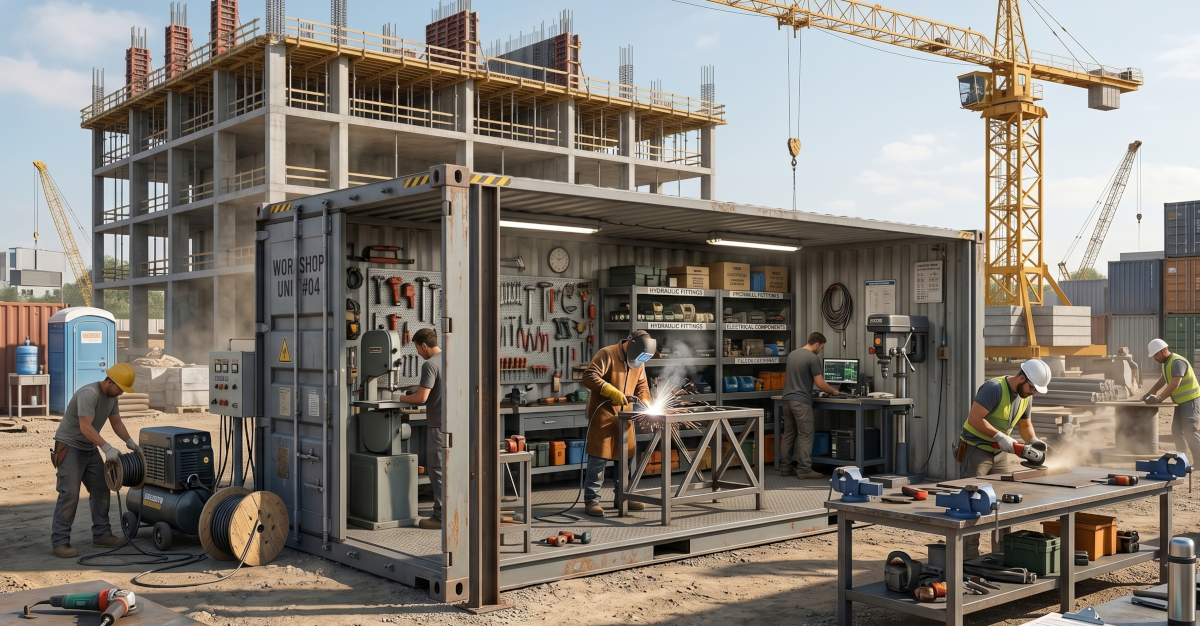
What makes container modular infrastructure special is its versatility. A single shipping container can become almost anything — and companies across the GCC are proving it daily. In commercial settings, converted containers serve as cafés, food stalls, mobile retail shops, event ticketing booths, and exhibition stands. In industrial and construction environments, they function as site offices, storage units, worker accommodations, and emergency medical rooms. And in hospitality and tourism, containers are finding new life as pop-up beach cabins, boutique desert retreats, and tourist information points.
Demand for mobile modular containers is especially strong in the construction and events sectors, where adaptability and rapid deployment are critical (kenresearch.com). And if your business relocates, your container moves with you.
The perfect fit for GCC mega-projects
The GCC is home to some of the world’s most ambitious developments, and modular container structures are supporting them at every stage. In Saudi Arabia, projects like NEOM and The Line are relying heavily on prefabricated and modular techniques — more than one-third of total buildings in The Line are expected to use modular construction (saudimarketresearchconsulting.com). Across the wider region, expanding ports, free zones, and industrial corridors are generating continuous demand for container-based offices, storage, and support facilities (programs.grc.net). Mega-projects demand agility — and nothing delivers agility quite like modular container solutions.
Built for a logistics-driven region
The GCC has established itself as one of the world’s most important logistics corridors. Maritime ports across the region — from Jebel Ali and Khalifa Port to King Abdullah Port, Sohar, and Hamad Port — serve as critical connectors between Asia, Europe, and Africa, with ongoing investments continuing to modernise the transportation ecosystem (programs.grc.net).

Container-based modular structures integrate naturally into this infrastructure — across ports, free zones, logistics cities, industrial parks, and customs checkpoints. For a region built on global shipping and trade, using containers as functional infrastructure is a logical extension of what they were designed to do.
The Future of GCC Infrastructure Is Modular, Fast, and Container-Based

The GCC is at a turning point. With a modular container market growing into the billions, national visions prioritising greener construction, and demand rising across every sector, shipping-container-based infrastructure is no longer an alternative — it’s becoming the standard.
At Boxcare, we’re proud to be part of this movement — helping companies across the GCC build modern, scalable, and sustainable spaces through expert container conversion, repair, sales, and leasing. If you need modular solutions that are fast, reliable, and built for your needs — we’re here to help.